
What Exactly Does a "Chip Design Engineer" Do in the AI Era?
A plain-English career map for students entering AI hardware, semiconductors, and deep tech.

Chip Design Is Not One Career. It Is a System of Careers.
After Issue #1, one question came up more than any other. Not, "Will AI replace engineers?" Not, "Which EDA tool should I learn?" Not even, "Should I learn Verilog or Python first?" The question was much simpler:
"What does a chip design engineer actually do?"
Many students hear words like VLSI, RTL, verification, DFT, physical design, validation, architecture, ASIC, FPGA, firmware, AI accelerator, but nobody explains how these pieces fit together inside a real chip company. So students end up thinking chip design is one job.
Chip design is not one career. It is a system of careers. And in the AI era, understanding that system may become one of the biggest advantages a student can have.
MARKET SIGNAL - WHY THIS MATTERS NOW

That means something very important for students: The world is not just building more AI models. The world is building the silicon those models depend on. And that silicon needs engineers, not just one type, but many types.
First, Let's Fix the Biggest Misunderstanding
A chip design engineer is not just someone who "writes Verilog." That is like saying a doctor is someone who "uses a stethoscope." RTL is important. But chip design is much bigger. A chip moves through a complete flow:
Application Need → Architecture → RTL Design → Verification → DFT → Physical Design → Silicon Validation → Firmware → Product / Application Support
Every stage has its own engineers, its own tools, and its own failure modes. A decision in architecture can create problems in RTL. A decision in RTL can create problems in verification. A physical design issue can show up during silicon validation. A firmware bug can make perfectly good hardware look broken.
This is why great chip engineers do not only understand their own block. They understand how their work travels through the entire silicon journey.
The Eight Career Tracks - Explained Simply
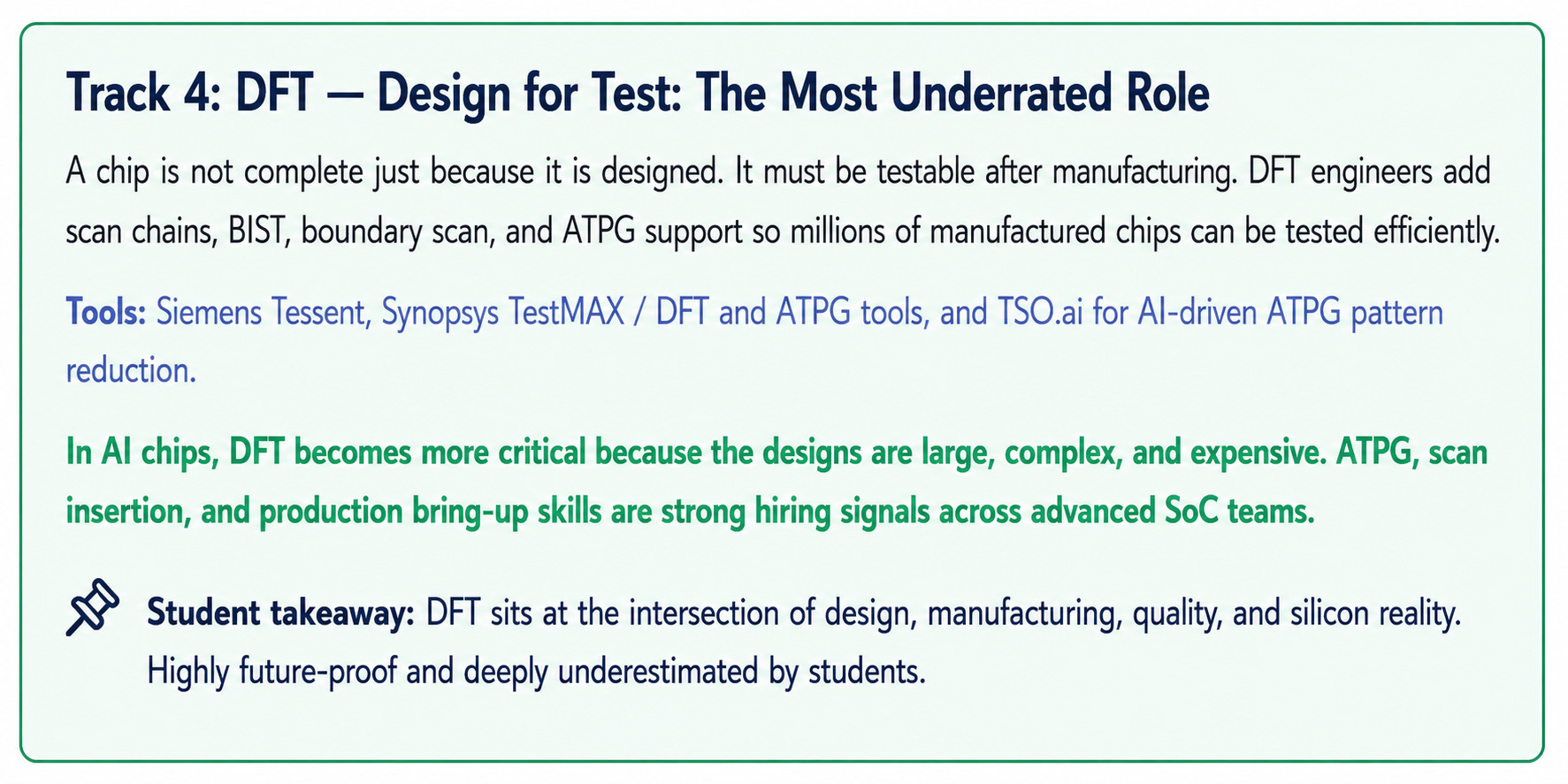
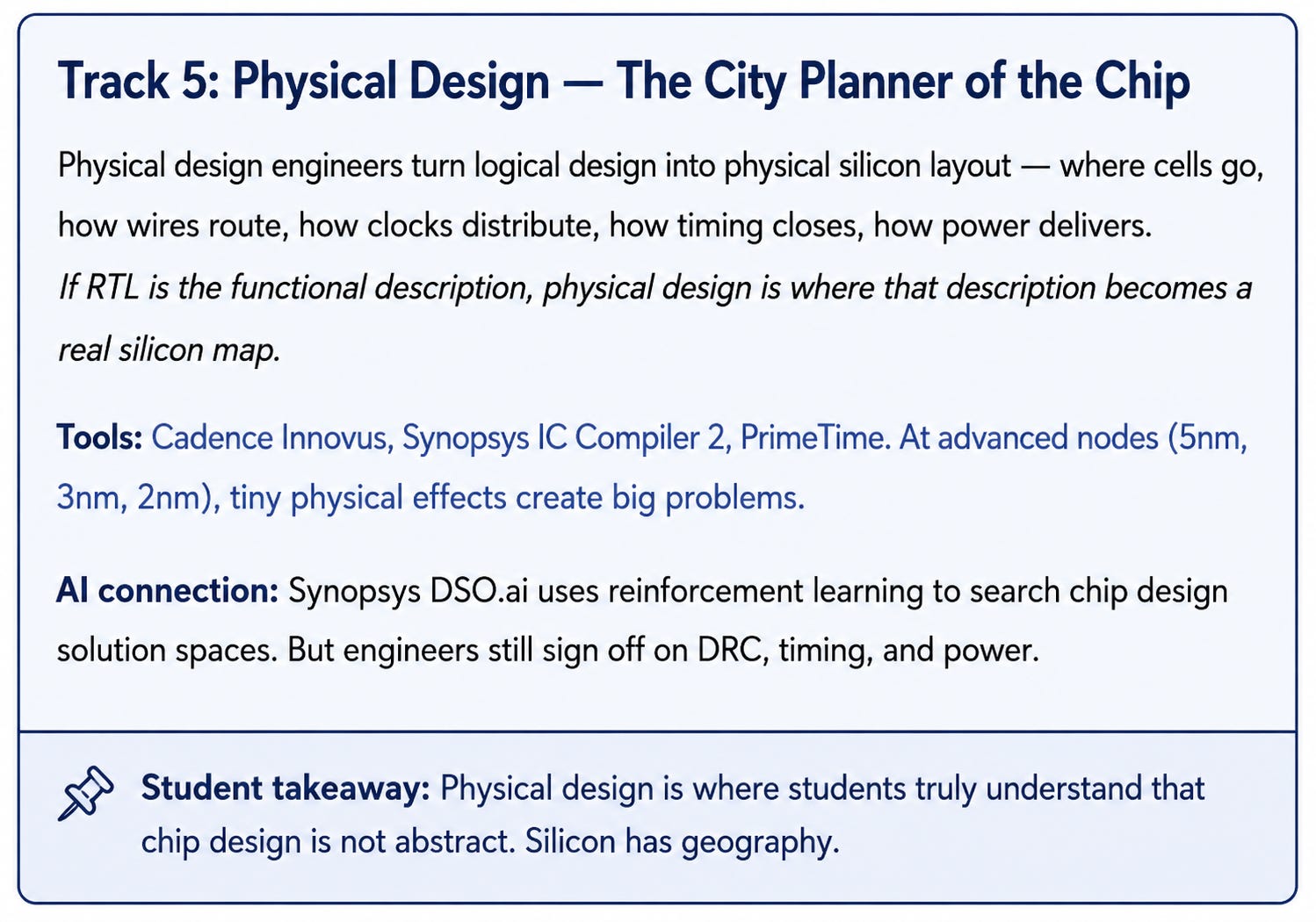
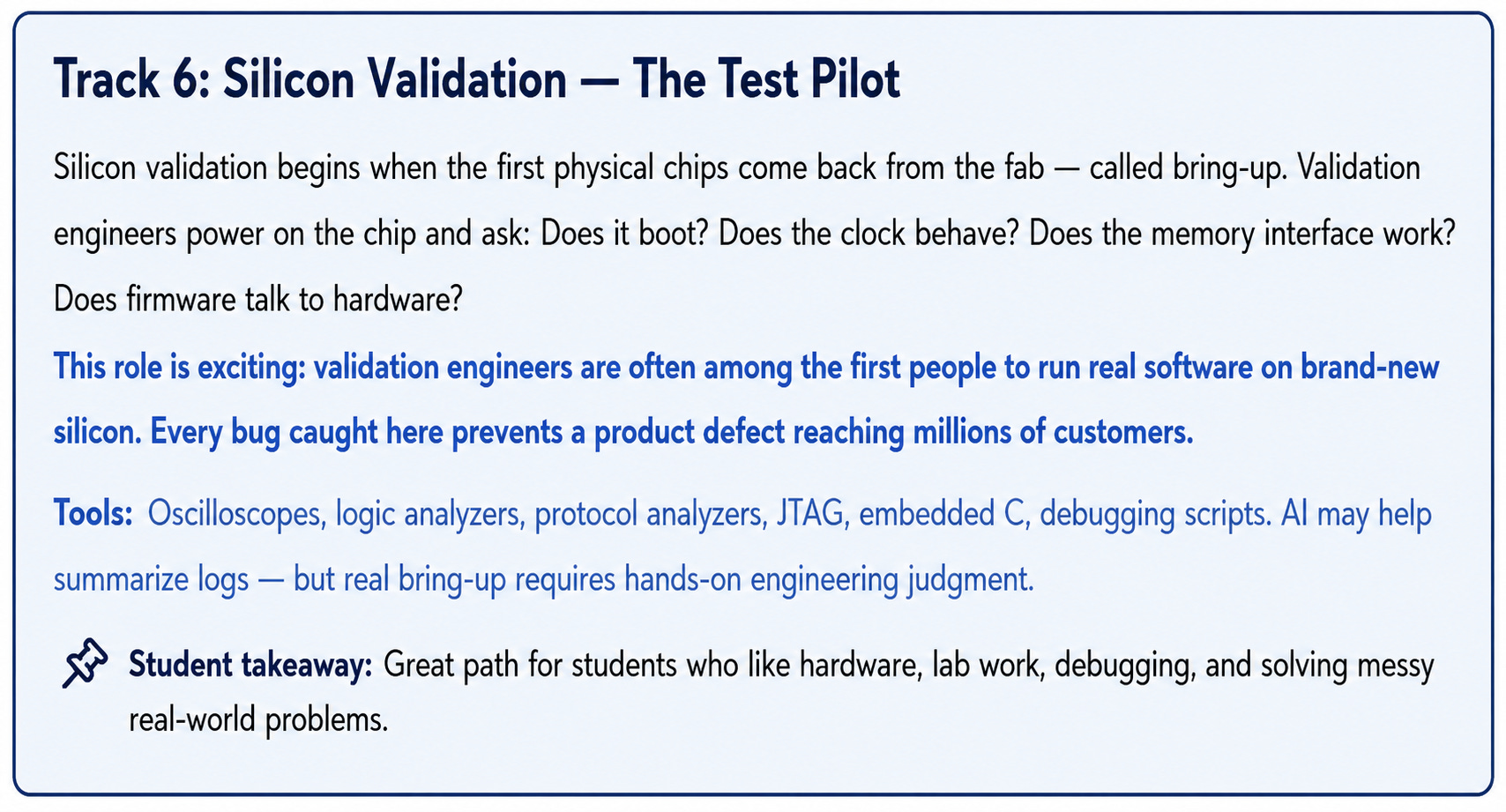
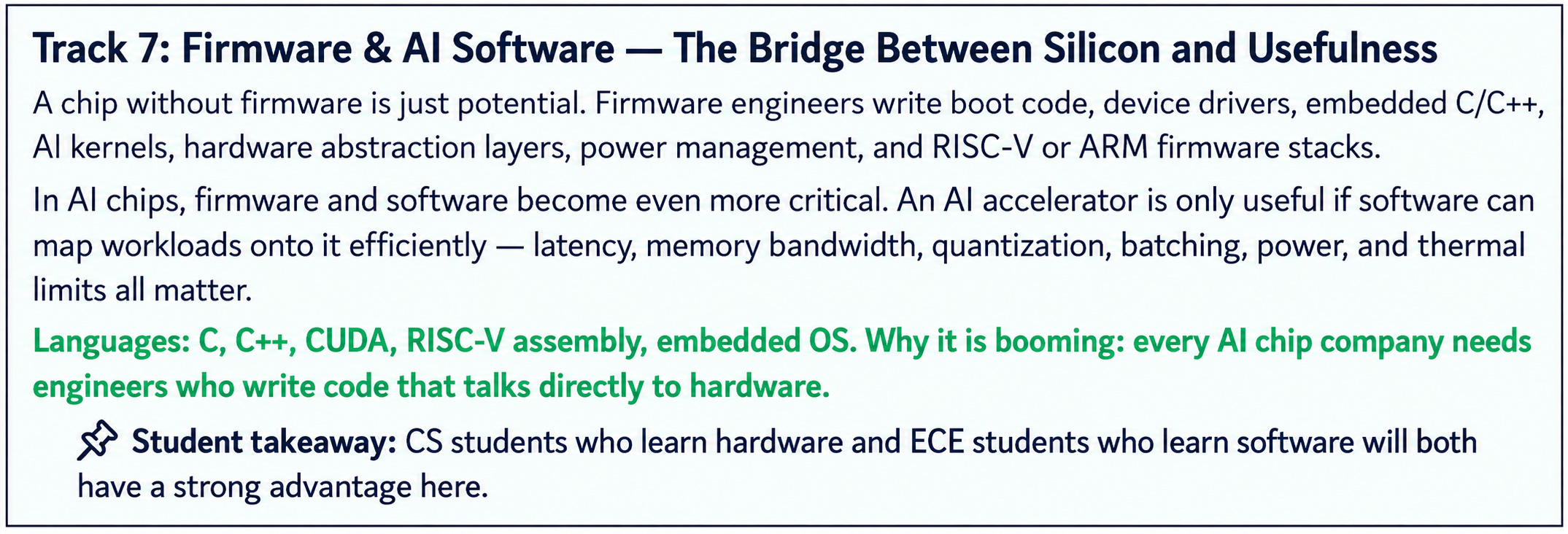
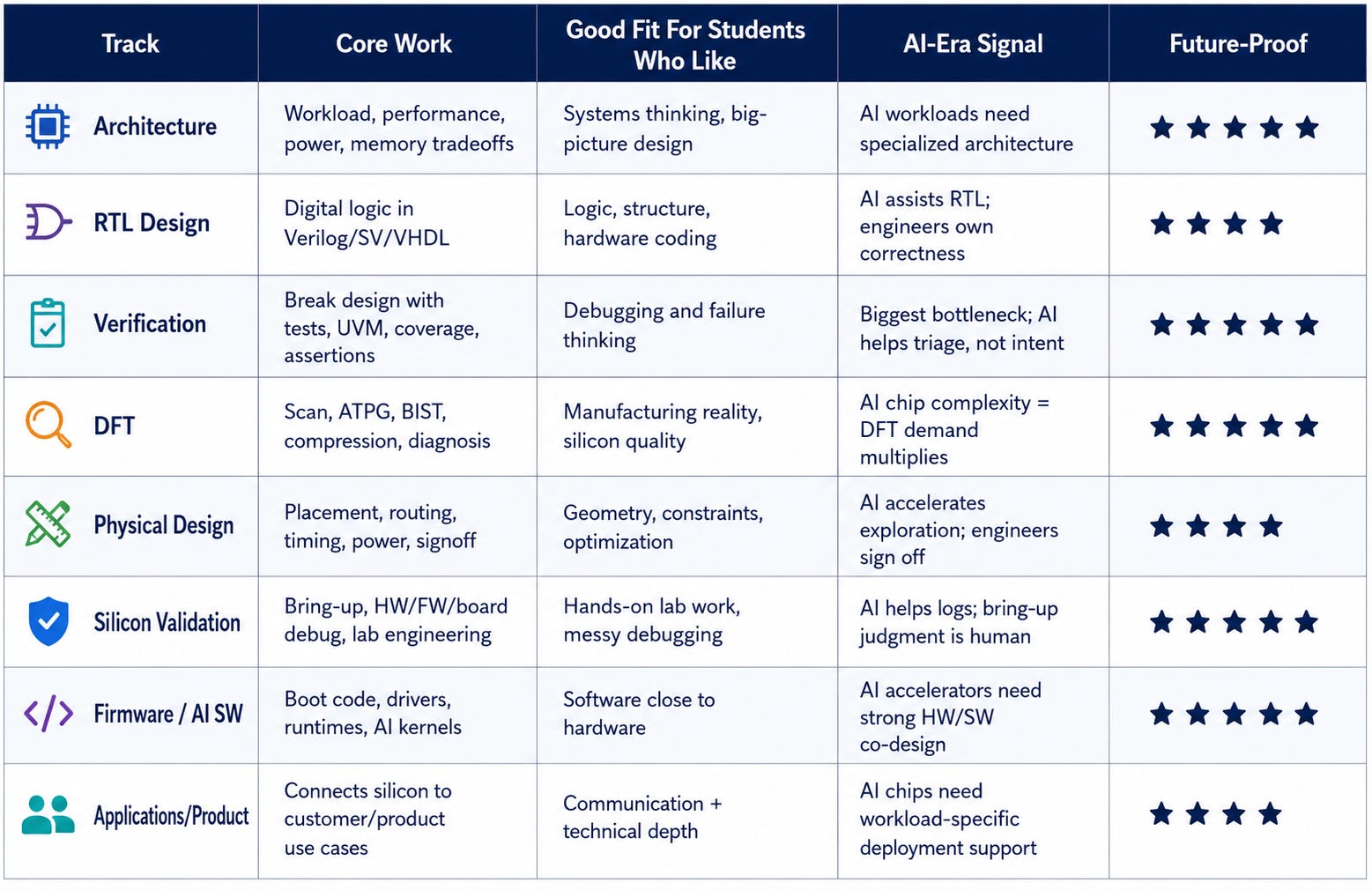
For students, I would simplify the AI-era chip design career map into eight major tracks. You do not need to master all eight. But understanding all eight and how they connect, is what separates a chip engineer from a chip professional.
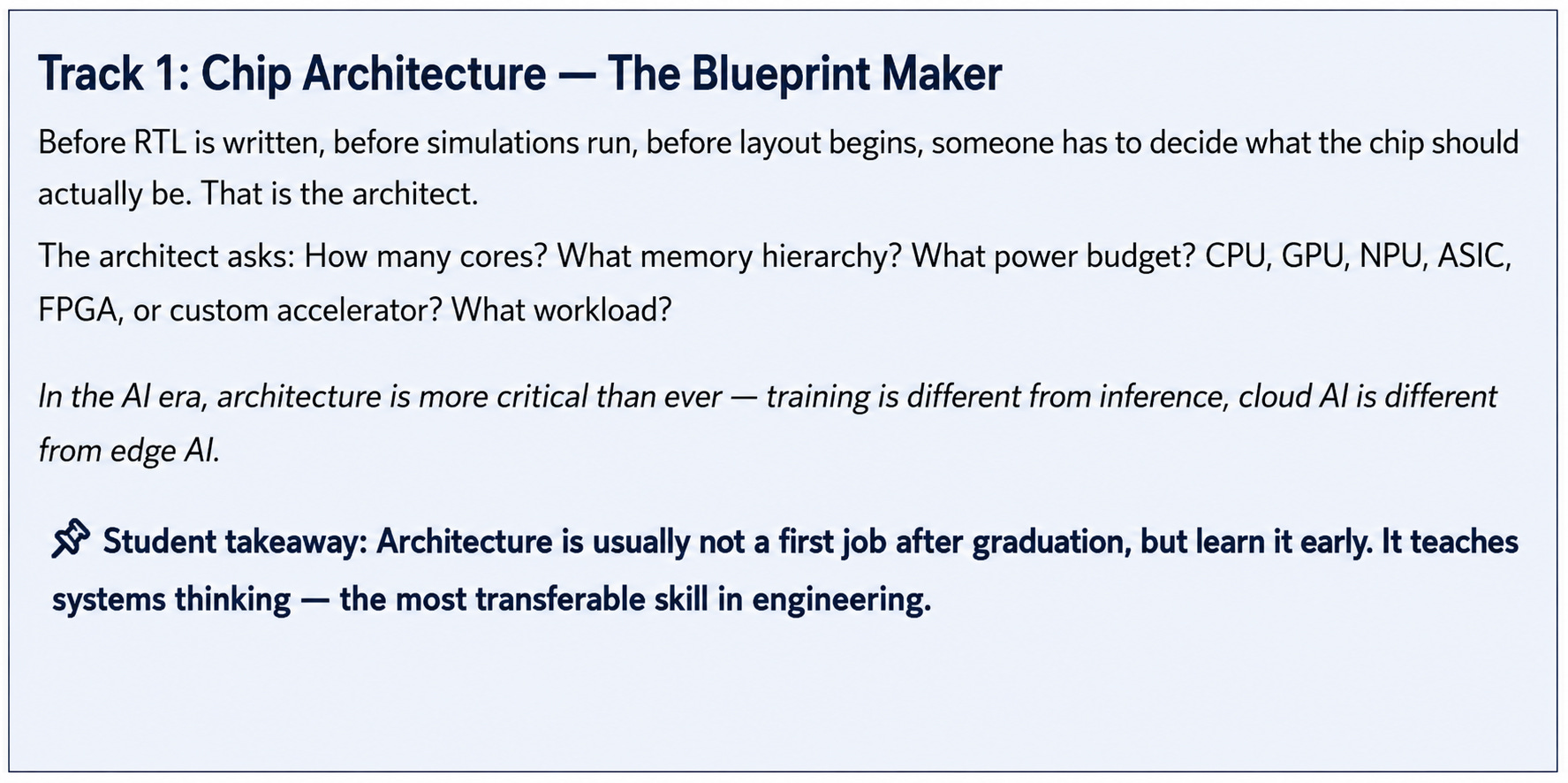
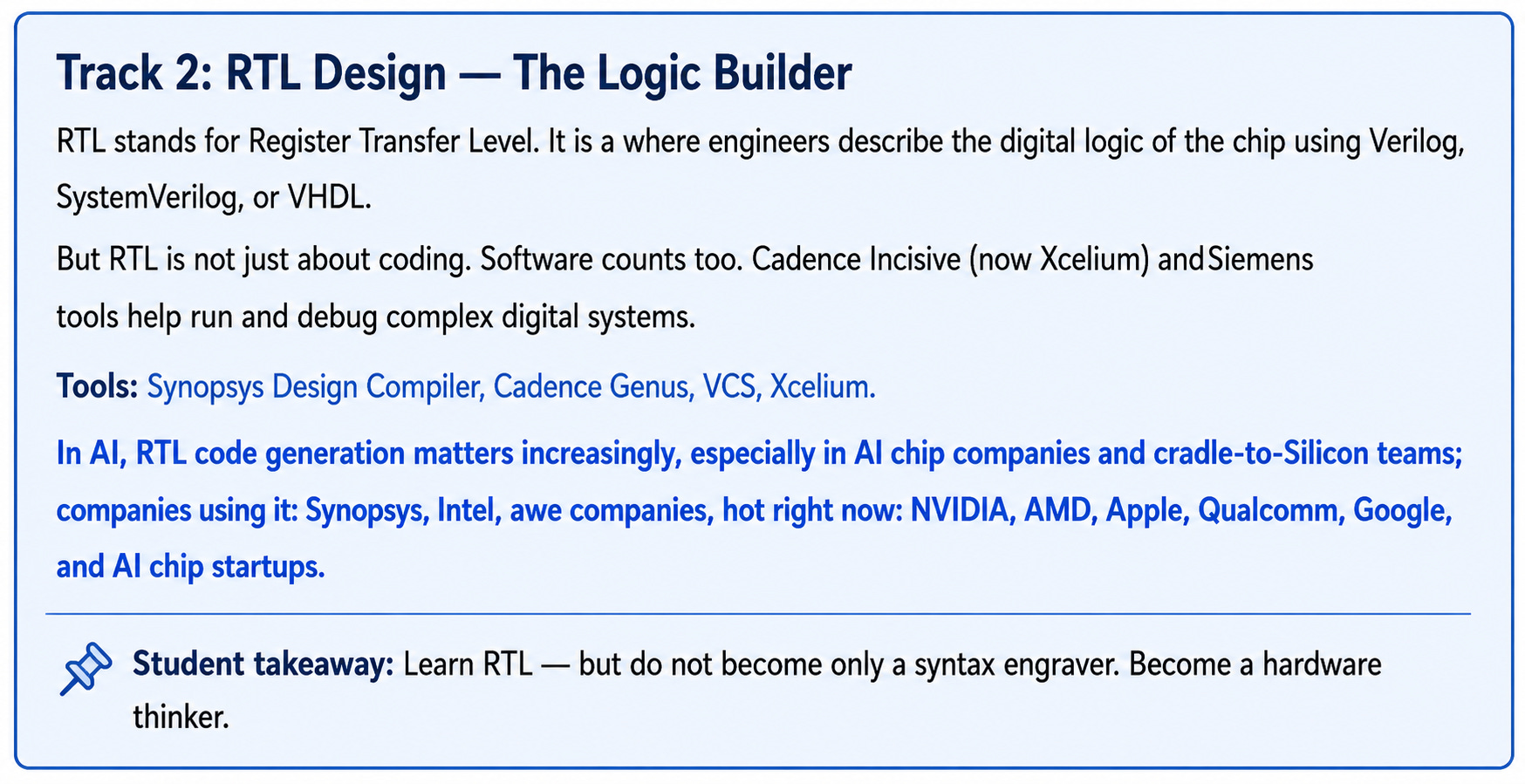
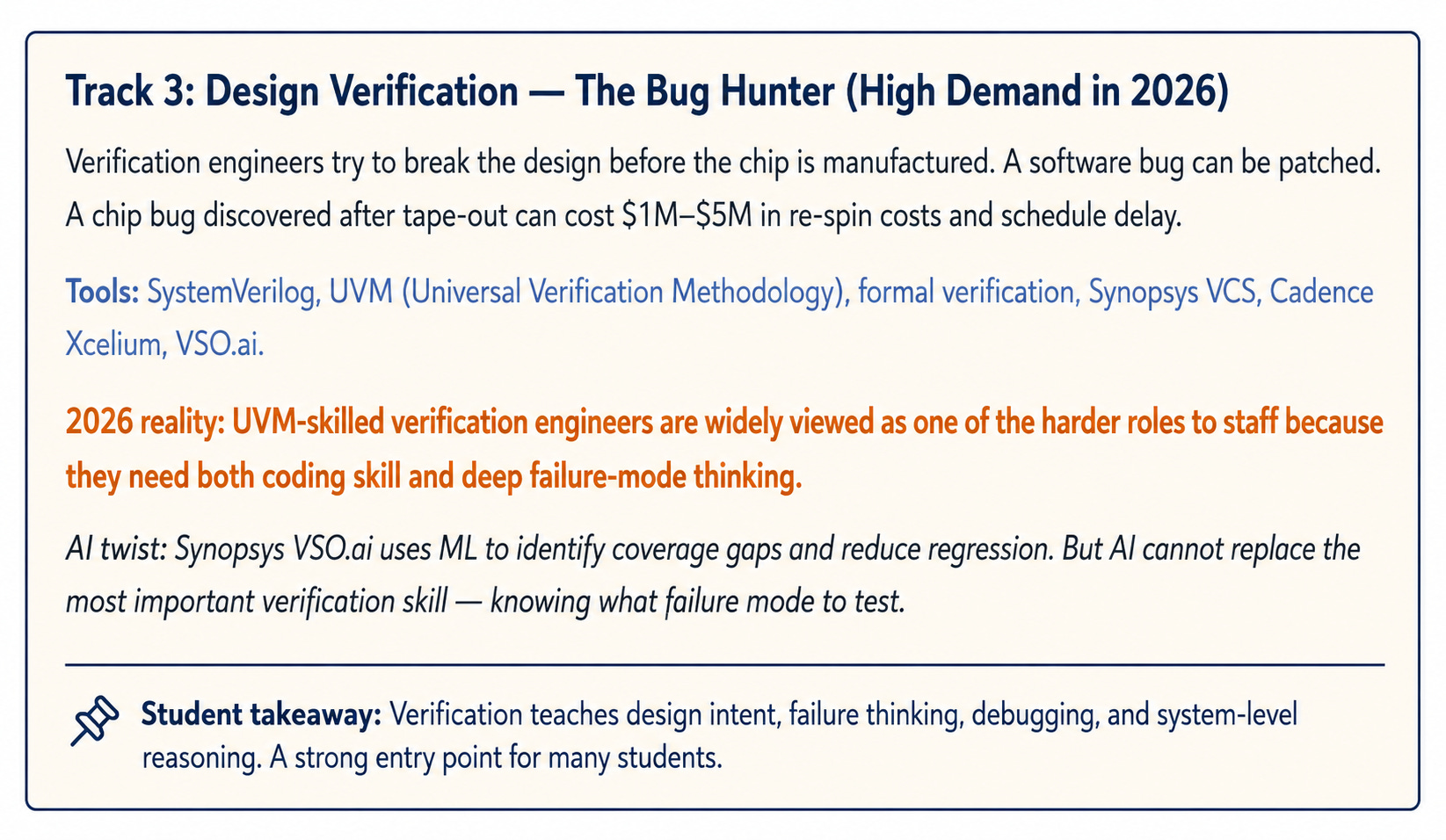
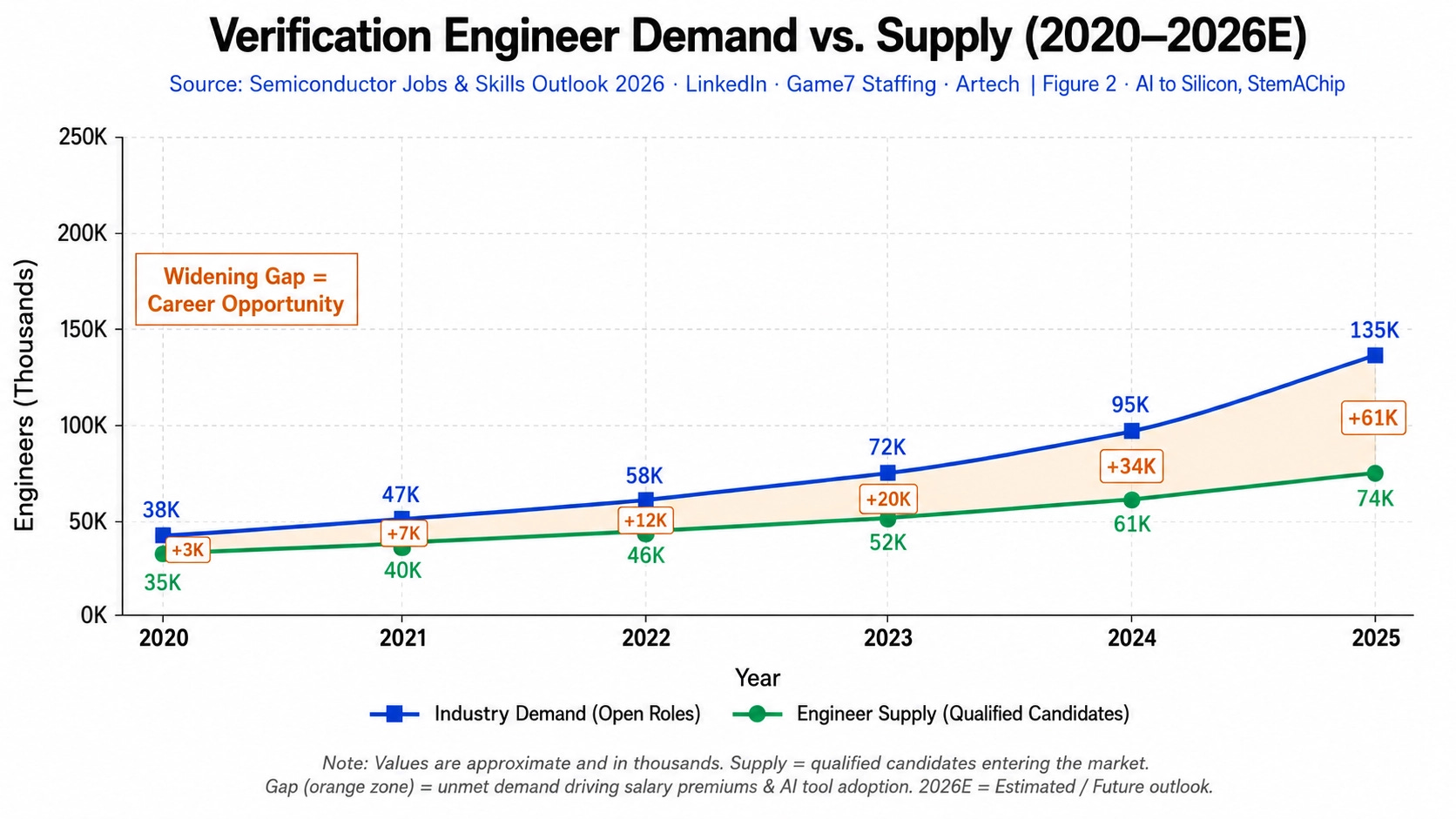
[Figure: Verification Engineer Demand vs. Supply 2020-2025E | Source: StemAChip analysis based on public job-posting and staffing signals; illustrative model]
ASIC vs FPGA: Why Students Should Understand Both
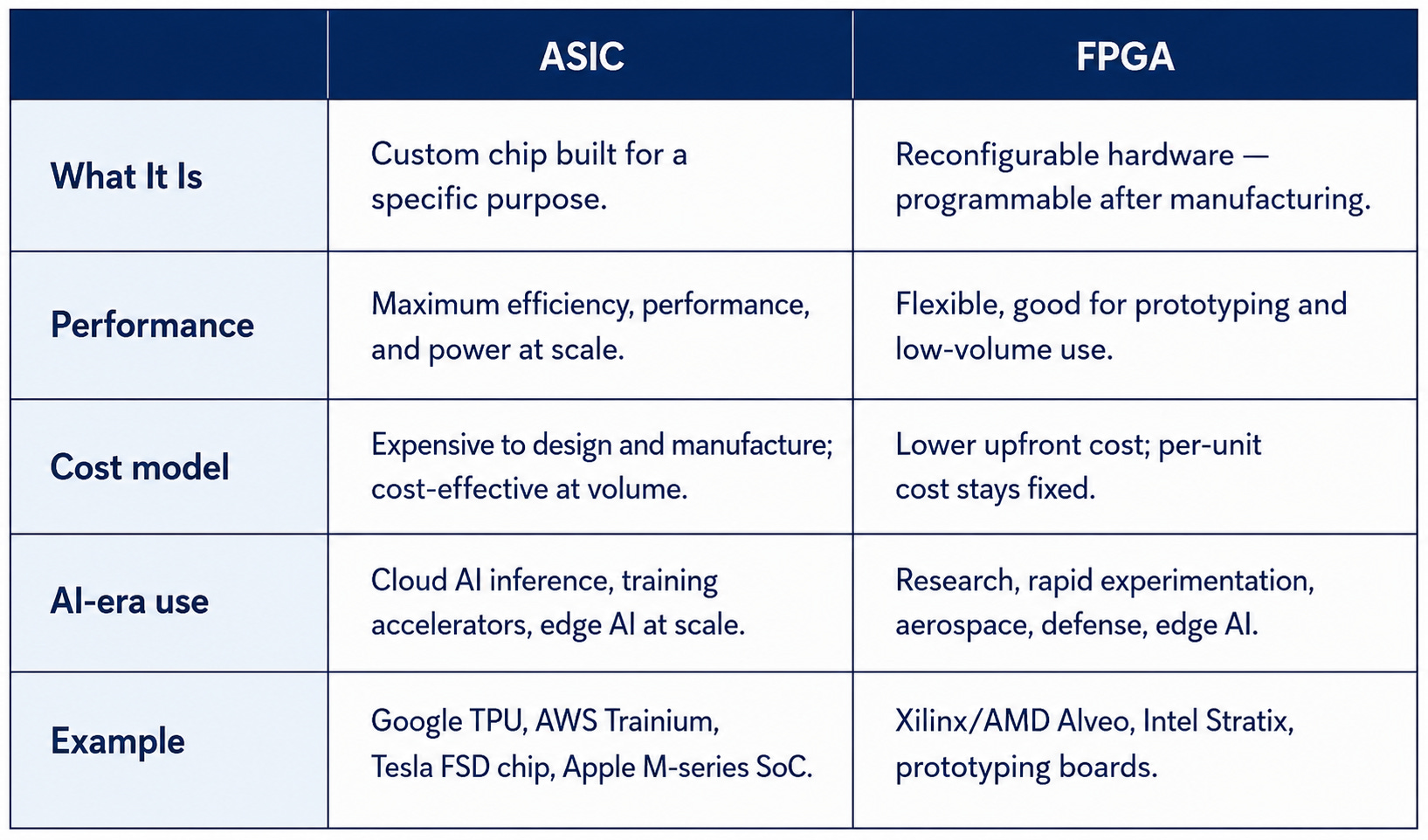
In the AI era, both matter. ASICs matter when companies need maximum efficiency at scale. FPGAs matter when companies need rapid experimentation or deployment flexibility. Students who understand both will have a broader career map and will be more useful across the full ecosystem.
Why Non-Chip Companies Are Now Hiring Chip Engineers
You no longer need to work at Intel or Qualcomm to be a chip design engineer. AI is pushing companies that were originally software or cloud businesses to build their own custom silicon, because at scale, AI workloads are too important to leave entirely to generic hardware.
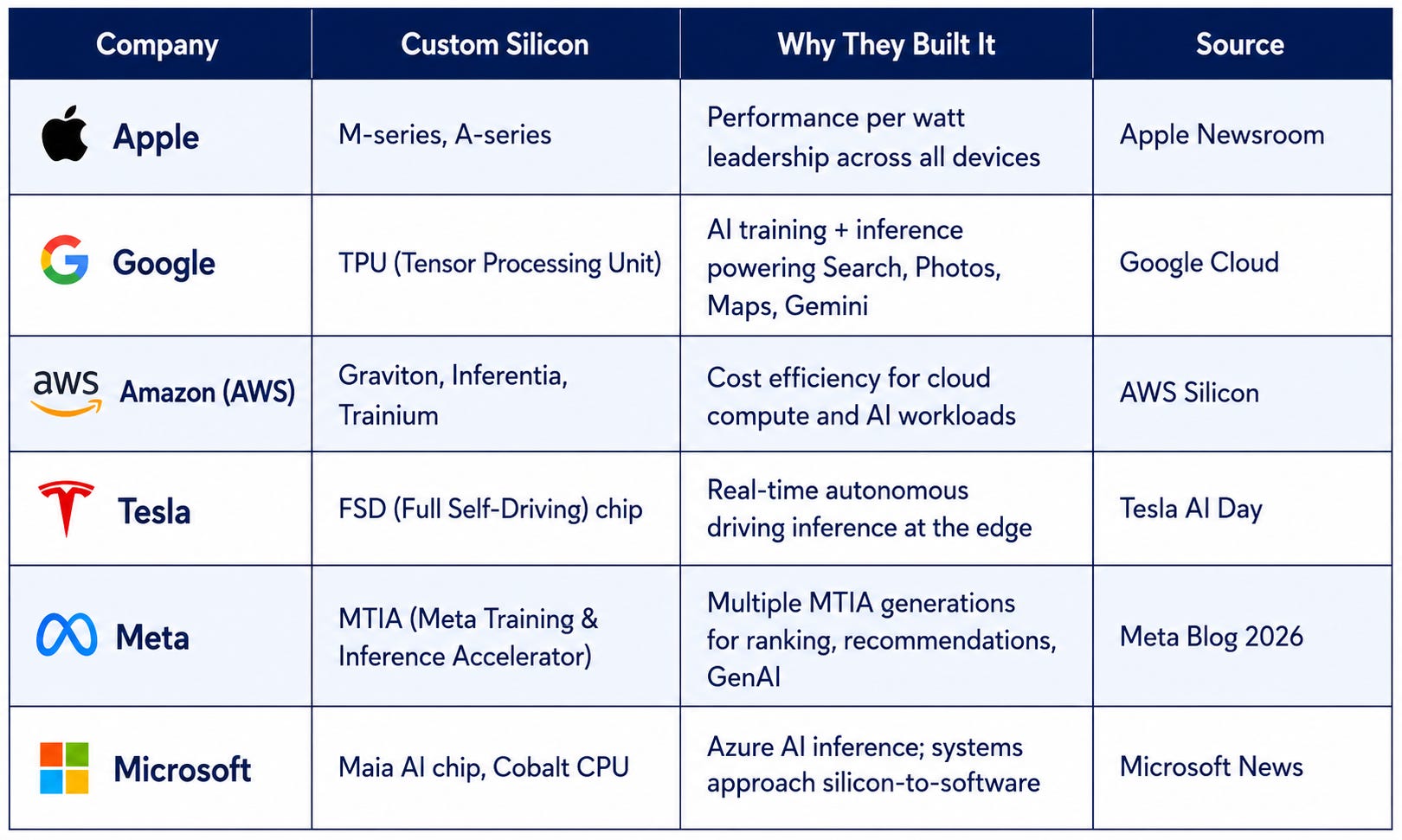
Chip engineers are now needed in: cloud companies, AI companies, automotive companies, robotics companies, defense organizations, medical device companies, consumer electronics companies, edge AI startups, and data center infrastructure companies.

[Figure: Global Semiconductor Revenue Growth & AI Chip Share 2020-2025E | Source: SIA, Deloitte 2026 Semiconductor Industry Outlook]
New Roles That Did Not Exist Five Years Ago
AI is not just creating demand for more GPUs. It is creating entirely new hybrid job titles at the boundary of hardware and AI. These roles were not in most job descriptions five years ago. They are now among the fastest-growing titles in semiconductor hiring.
● AI Hardware Engineer: Designs or optimizes hardware for AI workloads. Needs to understand architecture, memory, latency, quantization, compute patterns, and power.
● AI Accelerator RTL Engineer: Writes RTL for specialized blocks such as matrix multiplication units, tensor engines, memory controllers, and data-movement logic.
● Verification Engineer for AI Chips: Builds test environments for highly complex AI accelerators, SoCs, and chiplet-based systems. Needs strong UVM, assertions, coverage, and failure-mode thinking.
● DFT Engineer for Advanced SoCs: Designs test structures for complex chips where manufacturing quality and test time directly affect cost and yield.
● EDA Automation Engineer: Builds scripts, flows, dashboards, and AI-assisted automation around chip design tools. Needs Python, TCL, Linux, and EDA workflow knowledge.
● Hardware-Software Co-Design Engineer: Works across model behavior, firmware, compilers, runtime, and silicon. One of the most important AI-era roles. Comfortable in both RTL and Python.
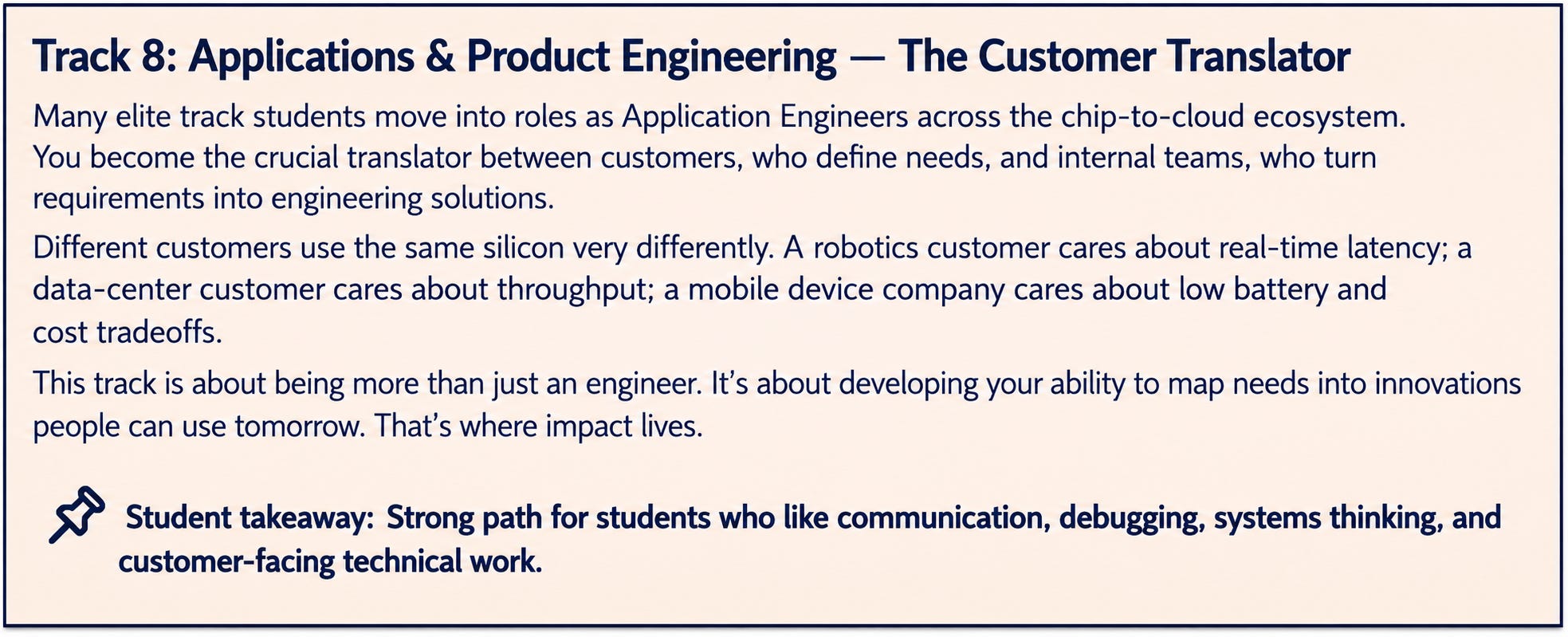
● Applications Engineer for AI Silicon: Helps customers deploy and debug AI hardware in real products. Needs technical depth and communication skills.
"AI helps designers find the best solution. Nobody loses their job. They just get to do a better job." - Synopsys Engineering Blog
AI-Era Chip Career Demand - At a Glance
What Students Should Do Right Now
Step 1: Learn the full chip flow before choosing a track. Do not start by saying “I only want RTL” or “I only want verification.” First understand the full journey - Architecture, RTL, Verification, DFT, Physical Design, Validation, Firmware, and Applications. You do not need to master all of them, but understand how they talk to each other.
Step 2: Pick one track and go deep. If you like logic and structure, start with RTL. If you like debugging and failure thinking, start with Verification. If you like manufacturing reality, explore DFT. If you like layout and constraints, explore Physical Design. If you like lab debugging, explore Validation. If you like software close to hardware, explore Firmware. If you like explaining technology, explore Applications Engineering.
Step 3: Do a project that crosses at least two tracks. Write RTL and verify it. Try running it through OpenLane. Write a Python script to parse simulation reports. Try connecting a simple hardware block to firmware. The moment students see how one decision affects the next stage, they stop memorizing and start engineering.
Step 4: Learn Python for engineering automation. Python is now a must-have support skill. Use it to parse logs, compare reports, analyze simulation results, generate checks, and build small utilities. Python is the glue between every track in the modern chip design flow.
Step 5: Learn AI from the hardware side. Do not only ask: “How accurate is the model?” Also ask: Where will it run? How much memory does it need? What is the latency target? What is the power budget? Can it run on edge hardware? Does it need a GPU, FPGA, ASIC, or microcontroller? That is the AI hardware mindset that will differentiate you.
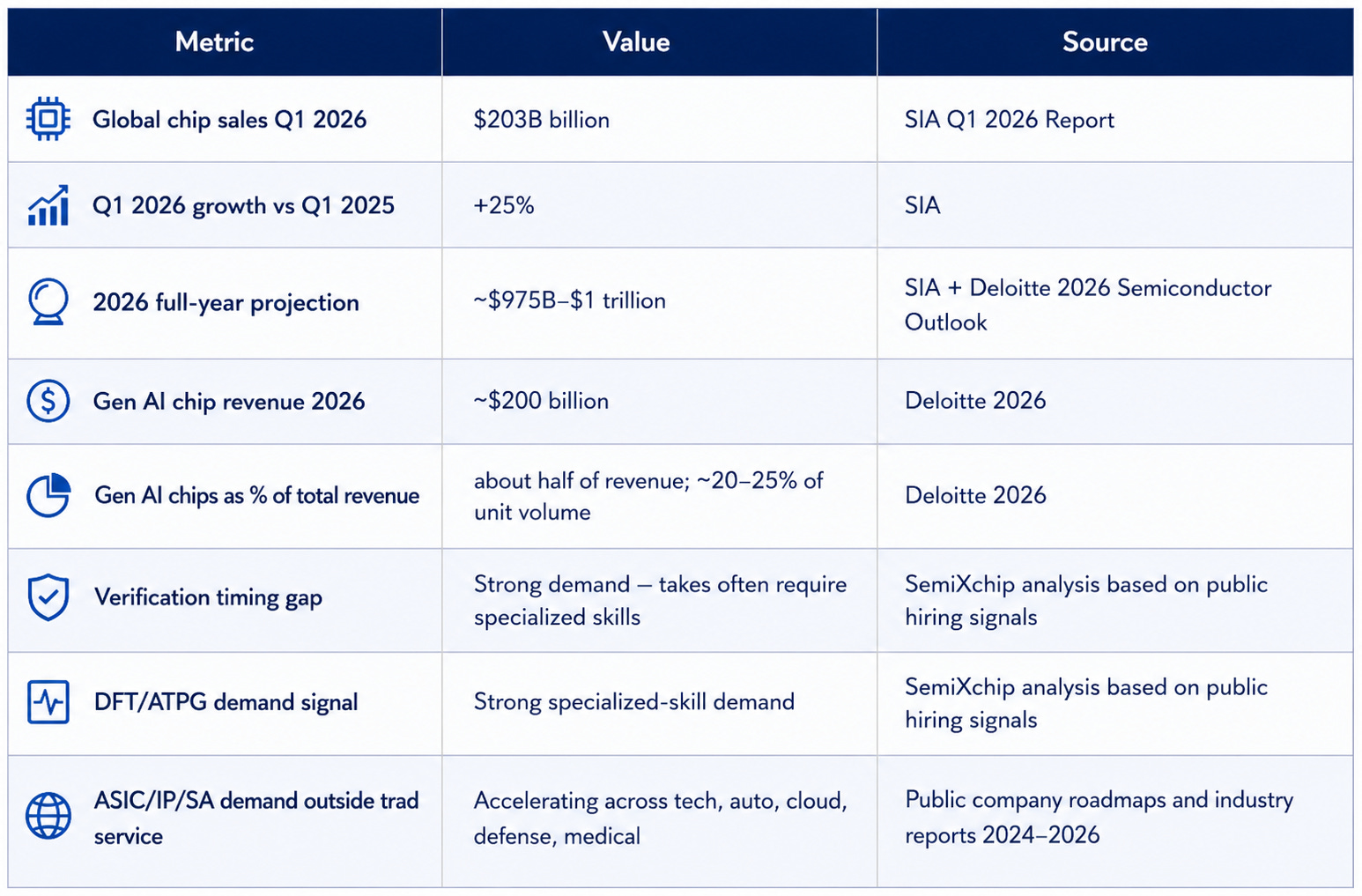
Key Market Data References
The Student Takeaway
"Don't just learn one subject. Learn how the subjects talk to each other."
The AI era will not reduce chip design into one simple job. It will make the field more connected. The best students will not be the ones who memorize the most tool commands. They will be the ones who understand the flow:
● How architecture affects RTL.
● How RTL decisions propagate through verification.
● How verification exposes design assumptions.
● How DFT makes silicon testable at manufacturing scale.
● How physical design turns logic into layout.
● How validation reveals truth after fabrication.
● How firmware makes hardware usable.
● How applications connect the chip to the real world.
That is what a chip design engineer does in the AI era. Not just one task. Not just one tool. Not just one language. A chip design engineer helps turn an idea into working silicon.
As AI pushes more companies to build custom hardware, the students who understand this full map will have a much clearer path into deep tech.
So the better question is not: “Which chip design role is best?”
"Which part of the silicon story do I want to own?"
Discussion Question
For students and early-career engineers:
If you had to choose one chip design career track today - architecture, RTL, verification, DFT, physical design, silicon validation, firmware, or applications engineering - which one would you choose and why?
Reference Links
● SIA - Q1 2026 Semiconductor Sales: https://www.semiconductors.org/global-semiconductor-sales-increase-25-from-q4-2025-to-q1-2026/
● Deloitte - 2026 Global Semiconductor Industry Outlook: https://www.deloitte.com/us/en/insights/industry/technology/technology-media-telecom-outlooks/semiconductor-industry-outlook.html
● Oregon SemiCentral - Semiconductor Career Pathways: https://semicentral.org/career-pathways/
● Cadence - ChipStack AI Super Agent: https://www.cadence.com/en_US/home/tools/system-design-and-verification/chipstack-ai-superagent.html
● Synopsys - VSO.ai AI-Driven Verification: https://www.synopsys.com/ai/ai-powered-eda/vso-ai.html
● Synopsys - TSO.ai AI-Driven Semiconductor Test: https://www.synopsys.com/ai/ai-powered-eda/tso-ai.html
● Synopsys - DSO.ai Design Space Optimization: https://www.synopsys.com/ai/ai-powered-eda/dso-ai.html
● Google Cloud - TPU: https://cloud.google.com/tpu
● AWS - Silicon Innovation: https://aws.amazon.com/silicon-innovation/
● Microsoft - In-House Chips for AI: https://news.microsoft.com/source/features/ai/in-house-chips-silicon-to-service-to-meet-ai-demand/
● Meta - Custom Silicon for AI Workloads: https://about.fb.com/news/2026/03/expanding-metas-custom-silicon-to-power-our-ai-workloads/